

Yesterday, my wife and I attended a tiny concert in Chadron, Nebraska, called For the Birds. It featured a husband-and-wife duo who combined instrumental music with climate-change awareness, which is a sentence that sounds like it was designed to make at least one uncle leave the room.
The timing was fitting. Earlier that day, Chadron had been hit by a large hailstorm and flash flooding. Chadron sits in a dry part of the country, but in about an hour, it received more rain than it had seen since the snow melted. There was so much hail on the ground that, despite temperatures in the high seventies, it looked as if someone had emptied sacks of snow across town and then fled the scene.
Most of the hail was pea-sized, which meant it mostly ruined people’s gardens while leaving windows, roofs, and cars mercifully intact. A very Nebraska compromise, your home survives, but the tomatoes are sacrificed.
It is not that I have never lived through hailstorms. On the East Coast, I barely experienced them, but in the Midwest, they are practically civic events. The worst one I remember was in Hastings in 2005. That summer, out-of-state contractors poured into town to take advantage of the sudden demand for new shingles and gutters. I even worked under the table for a few weeks, doing eight-hour days. I was only sixteen.
The man I worked for remains vivid in my mind, mostly because he appeared physically incapable of going more than thirty seconds without a cigarette in his mouth. I had seen chain smokers before, but this man treated cigarettes like oxygen with branding. He claimed he was going back to Tennessee to get more supplies after two weeks of roofing houses. We never saw him again. Perhaps he is still on the road somewhere, driving through America in a truck full of shingles and Marlboros.
Another thing I remember about that storm is how oddly selective it was. In Hastings, the railroad divides the north and south sides of town. The storm seemed to understand municipal geography. It damaged the south side and spared much of the north, as if the clouds had been consulting a zoning map.
Yesterday, after the storm passed, Diya and I swung by the Mari Sandoz High Plains Heritage Center on Chadron State College’s campus to open the doors for the concert. Then we went home, changed out of our rain-and-hail clothes, and returned.
The concert itself was lovely. Nelda Swiggett played piano, while her husband, Clif, played drums and trombone. The music flowed with the subject matter, soft, uneasy, beautiful, and occasionally ominous, which is probably the correct soundtrack for discussing the planet at this point.
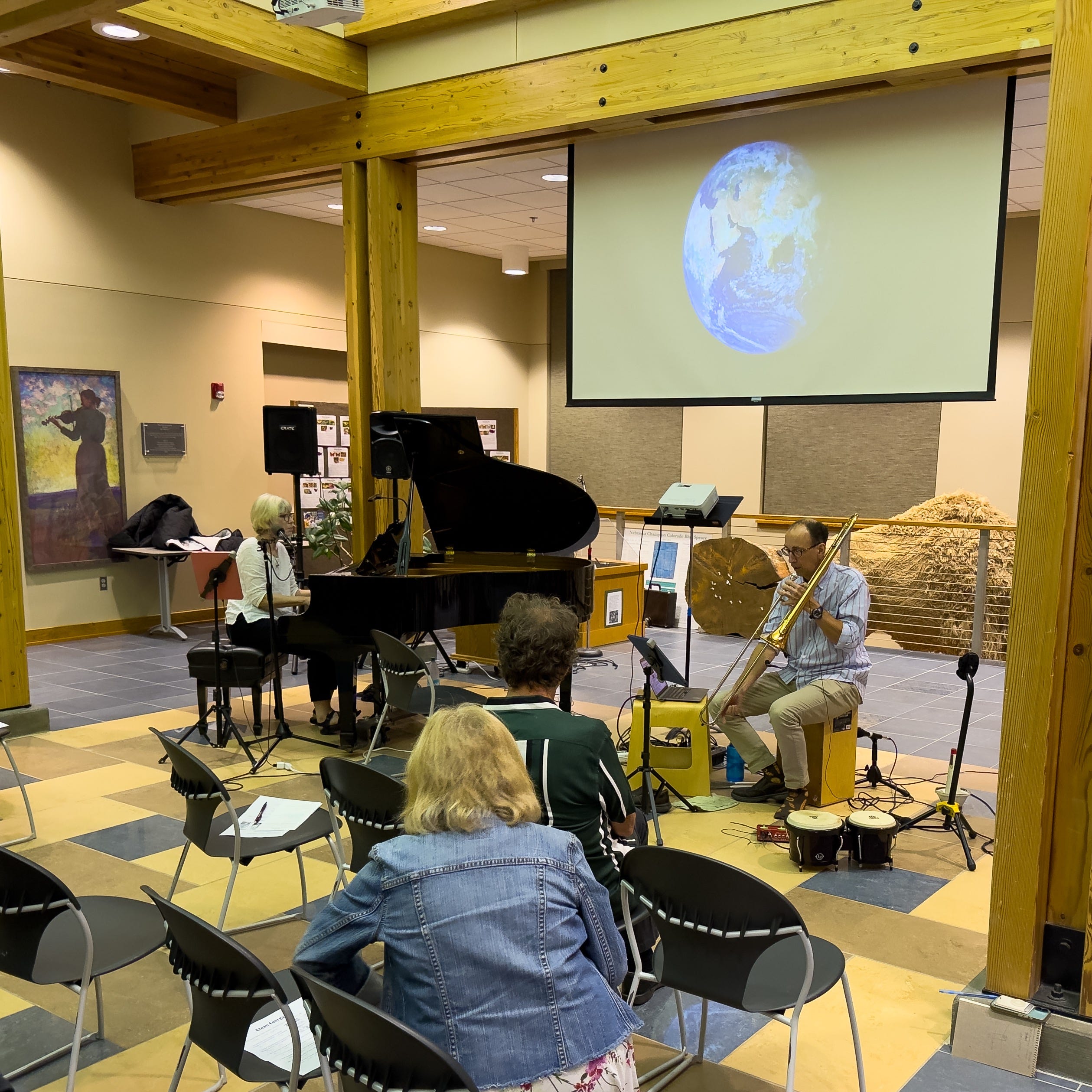
They spoke about birds and climate change, and the point that stayed with me was simple: humans can adapt, at least somewhat. Animals often cannot. Birds depend on timing. They migrate according to ancient clocks, but the clocks are now being tampered with by a species that also invented the leaf blower.
Spring can arrive weeks early. Sometimes there are false springs. Birds arrive expecting insects, nesting material, food, and the usual seasonal welcome basket, only to find that the timing is off. If they arrive late, the resources they need may already be gone. If they arrive during a false spring, the next cold snap can freeze the insects they depend on, and sometimes the birds themselves.
They also talked about fires. Birds are especially vulnerable to smoke. There is a reason miners once carried canaries into mines. Birds are more sensitive to toxins, which makes them useful warning systems and, rather unfortunately, victims of our habit of turning landscapes into chimneys.
And it is not as if Nebraska is immune. This year alone, the state has experienced major wildfires. The Great Plains are not some distant postcard where climate consequences happen politely off-screen. They are right here, burning, flooding, drying out, and then occasionally covering themselves in hail for theatrical effect.
Of course, some people still insist this is all natural. Nothing to see here. Just regular weather. Just a normal century. Just the earth coughing politely while the room fills with smoke.
The concert also touched on polar vortices, which always bring out a familiar chorus, “If climate change is real, why is it cold?” This argument usually arrives with the confidence of a man who has confused weather with climate and thinks the distinction is elitist. Yes, it can snow in Texas. No, that does not disprove climate change. That is like saying hunger is fake because you once ate lunch.
Trying to explain this to certain people is like trying to explain supply chains to a cat. The cat does not care how the food arrived. The cat cares that the food is in the bowl. If it is not in the bowl, the cat assumes you have personally failed civilization.
At the end of the concert, they gave us a pop quiz and a list of ways people can make environmentally friendly choices. I do believe small choices matter. I really do. But I also think we have become far too comfortable pretending that the fate of the planet hinges on whether I rinse out a yogurt container correctly while billion-dollar companies treat rivers like open sewers.
America has a talent for this. We are very good at making ordinary people feel responsible while letting the powerful write the terms of destruction. We tell people to recycle while allowing industries to pollute the air, water, and land at scales no household could ever dream of achieving. We scold individuals for plastic straws while entire systems are built around fossil fuels, overconsumption, sprawl, and the sacred American right to sit alone in traffic in a vehicle the size of a studio apartment.
We should still do our part. But our part should not become a moral smokescreen that lets corporations and policymakers stroll away whistling.
The rich and powerful have done a remarkable job convincing everyone else that the problem is either too complicated to understand or too inconvenient to fix. They have made education expensive, expertise suspicious, public goods unfashionable, and television loud enough to drown out thought. They have built a world where being informed is treated as pretentious and being confidently wrong is treated as authenticity.
This is not an accident. An educated public is harder to rob. A distracted public is easier to manage.
Then there is transportation. America has spent decades making reliable public transportation feel impossible, or worse, vaguely un-American. High-speed rail is treated like a fantasy, even though much of the developed world has already figured out that trains are not witchcraft. But if people can travel efficiently without buying cars, gasoline, insurance, and endless repairs, someone very wealthy becomes slightly less wealthy. Naturally, this cannot be allowed.
So we sit in traffic. We burn fuel. We build more lanes. Then we act surprised when the air gets worse, the weather gets stranger, and the birds begin to disappear.
Industry, too, has been allowed to pollute public goods while keeping private profits. The public gets the sludge, the smoke, the asthma, the poisoned water, the flooded towns, and the burned habitats. The executives get bonuses, retreats, and perhaps a tasteful beach house somewhere far from the consequences.
It is a beautiful system, if you are a ghoul.
So what do we do?
For one, we stop pretending this is only about individual virtue. Yes, recycle. Yes, consume less. Yes, think about what you eat, drive, buy, and waste. Those things matter. But they are not enough. We need regulation with teeth. We need public transportation that is actually public and actually transportation. We need to make pollution expensive for the people who profit from it, not merely inconvenient for the people who suffer from it.
We also need to read more and be lied to less. Turn off some of the noise. Pick up a book. Learn how systems work. Ask who benefits when you are angry at the wrong person. Do your own research, not the kind that involves watching a man yell in a studio, but the kind that requires patience, evidence, and the occasional admission that you may have been wrong.
America was not supposed to be a land where the richest people could strip public goods for parts while everyone else argues over the scraps. At least, that is not the version we like to tell ourselves. We talk endlessly about freedom, but freedom means very little if the air is poisoned, the water is unsafe, the land is burning, and the birds no longer know when to come home.
The concert was called For the Birds. It was small, gentle, and earnest. Outside, the town was still drying out from a storm that had briefly made May look like winter. Inside, two musicians reminded us that birds are not simply background decoration for our lives. They are witnesses. They are warnings. They are living clocks.
And lately, the clocks seem confused.
Which should worry us. Because when the birds are in trouble, it usually means we are not far behind.