

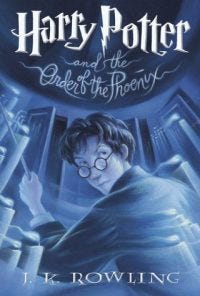
Writing a review of a book that was so popular that people waited in line at midnight to buy it from Walmart over 20 years ago seems like a very niche thing to do. Of course, this isn’t even one of the first four books in the series, but the fifth one. That could be a little recency bias, as I just finished Harry Potter and the Order of the Phoenix for the third time this past week. Actually, I have been rereading all the Harry Potter books from start to finish, just as I did during the COVID lockdown.
Before a few years ago, I would have thought rereading a book was pointless, even though I know many intellectuals love to do it. I’ve heard about the benefits, like spotting old clues in mysteries, seeing how your perspective changes from the first time you read something, and even that rereading is supposed to help you read faster.
Recently, I have reread a handful of series, not just the Harry Potter series, but also The Hunger Games trilogy, the James Bond novels, and my favorite, the Hercule Poirot mysteries. I do have to agree that each read is unique, and it is funny how we remember things. For example, in Harry Potter and the Chamber of Secrets, I had built up the scene where everyone finds out that Harry can talk to snakes, though in the book it goes by rather quickly.
And this is where the review of this book is heading. In truth, the first two times I read this book, I considered it my least favorite book in the seven-book series. I always called it The Book Where Harry Whined the Entire Time.
Now, there was a gap between when I originally read the fourth and fifth books. I grew up with these books and was either in middle school or high school as they were coming out in America. Even when I reread the series for the second time, in 2020, I found that my opinion of the fifth book had not changed that much. I read all seven books back-to-back over a two-month period then, and I still found Harry quite annoying. It wasn’t as irritating as it had been the first time, but he was still annoying.
However, with this past reading, my opinion changed quite a bit. Now, I see the signs of the trauma Harry has gone through. He had just seen Cedric die in the previous book, and in my previous readings, I don’t think I gave enough weight to what Harry had experienced.
I think part of that was because of how I perceived the series. They are young adult novels set in a fantasy world with magic. How much could these books really show what it is like for someone to go through trauma? So, each time before, I think I dismissed it.
This time, though, I was much more open to the idea that J.K. Rowling did a wonderful job showing how trauma could alter a person’s psychological state. You can see it with Harry. He is paranoid, angry, and increasingly convinced that he is the only person capable of bringing down the Dark Lord.
For example, when he first joins Ron and Hermione after once again staying with his aunt and uncle, he explodes at them. He talks about how he has defeated the Dark Lord multiple times and argues that he should be involved in the Order of the Phoenix, even though Ron and Hermione are also excluded from it. He is furious that they are at least in the house where everything is happening while he has been stuck with his aunt and uncle.
Rereading it for the third time, I actually see the pain Harry is going through. I don’t just register this as a young adult fantasy book anymore, but as a proper fictional story dealing with real emotions and consequences.
I have always talked about how the Harry Potter movies grew up, from being children’s movies to much darker, more adult movies as they progressed. And while I understood that the books did the same thing, I don’t think I ever gave them the credit they deserved.
Another theme throughout the book that I didn’t pay much attention to before, but noticed much more this time around, is how hard the Ministry of Magic works to discredit Harry and Dumbledore by insisting that Voldemort isn’t alive. It is something that can easily happen in today’s world.
There are instances where wealthy people or powerful institutions can influence which stories are told, how they are framed, or whether they are told at all. Companies can buy publications, powerful people can buy access to the media, and stories can be buried when they threaten the interests of those in power.
That doesn’t mean you should distrust everything you read in the media because someone read Harry Potter and the Order of the Phoenix. I am not saying you should rise up against the government either. What I am saying is that there are instances in which governments, wealthy individuals, and powerful institutions have manipulated stories in ways that leave ordinary people unaware of the truth.
That is something the book handles surprisingly well. The Ministry does not simply deny what Harry is saying. It tries to make him appear unstable, discredits Dumbledore, and uses the media to shape public opinion. Reading that part of the book now feels very different from what it did when I was younger.
In the end, I was glad to have reread Harry Potter and the Order of the Phoenix for the third time. Not only have I always enjoyed Harry Potter, like every other millennial, but I also think it is interesting to see where I was as a person from one reading to the next. I wanted to believe I knew it all the first time I read it, and probably thought the same thing when I reread it in my early 30s during COVID. Now, reading it again, I see the book with a new perspective on Harry and the trauma he is going through. And I am sure the next time I read it, I will see it differently again.
I am inspired to re-read the series.