

Growing up as a kid in the 90s, one thing that was always exciting was the James Bond marathons that aired each December. They usually started sometime after Thanksgiving and would run all the way to Christmas.
Of course, growing up in North Dakota in the 90s meant that one was often limited to things inside. The winters are brutal, snow is on the ground by Halloween, and it is nighttime before you realize the sun ever rose.
And while there were many things on television starting around Thanksgiving, the Bond movies were much preferred to any Christmas classic. I mean, even today, I am not one to watch Christmas movies. My colleagues have given me much grief for not having watched such classics as A Christmas Story, It’s a Wonderful Life, and Miracle on 34th Street. Maybe the reason I never watched Christmas movies was because of those James Bond marathons. From Dr. No to GoldenEye, it didn’t matter. James Bond was the spy we enjoyed watching.
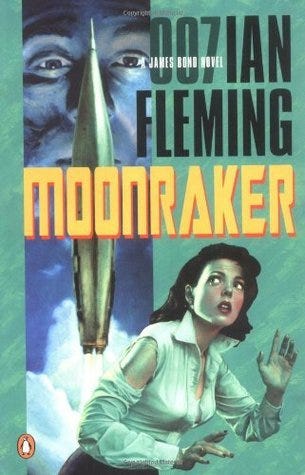
Thinking back on it now, it didn’t even matter who was playing Bond. I think, as a kid, Roger Moore’s portrayal was the one I liked best because the movies had become more comical during his time as Bond. Though, if I had to pick my favorite Bond now, I would not hesitate for a second to say the OG, Sean Connery. However, this is neither here nor there. The whole reason for bringing up Bond is because I wanted to talk about my favorite Bond novel, Moonraker. I just finished reading the book for the second time, and it confirmed what I already thought, this is the best Bond novel.
Now, some of you reading this are probably thinking that the novel is similar to the movie. However, while there was a Bond movie made with the name Moonraker, that is about where the similarities between the two end.
This may make more sense for people who have only watched the Bond movies. The original books by Ian Fleming were published between 1953 and 1966 and took place during that time period, while the movies have consistently been updated to take place in modern times. So, the novel, published in 1955, didn’t even hint that space travel was possible, while the film, trying to cash in on the Star Wars and Star Trek fandoms, shows Bond using lasers and going into outer space. It makes me wonder what Ian Fleming would have thought of the film.
Before I go any further, I would like to put a spoiler alert here for anyone interested in reading the original Bond novels without knowing all the details. Even if you do not read any of the other Bond books, this one should be on your reading list. While I am still talking about the novels, one of their biggest endorsements came from President John F. Kennedy. He was a big fan of the books and even publicly praised From Russia with Love, which helped cause sales in the United States to surge.
Anyhow, let’s get back to the book. The novel follows Bond as he saves London from nuclear destruction at the hands of a group of German Nazi sympathizers seeking revenge. This is all possible because one German is misidentified as Hugo Drax and becomes an English war hero, even though he is actually German. Through this misidentification, he is able to use his knowledge and newfound position to become a millionaire, the equivalent of being the Elon Musk of his day.
Hugo Drax promises to defend England from all of her enemies by building a rocket that can strike anywhere on the European continent. Even though the novel doesn’t directly say Russia, it is implied that the missile could be used to strike Moscow if needed.
All of England is excited about the missile. The first rocket, almost completed, will soon be launched as a test. Bond, who normally doesn’t work cases inside the country, gets involved when a Scotland Yard agent is killed a week before the missile is scheduled to launch. Bond, with the help of another undercover agent, Gala Brand, finds out that Hugo Drax is actually German and is dead set on blowing up London as revenge for the war.
Bond goes through great pain after being captured to ensure that this plan doesn’t happen. He is beaten, doused in hot steam, and burned while trying to make sure the rocket will not hit London. All of this happens while the test firing of the rocket is being broadcast live by the BBC. Hugo Drax and his German compatriots had help from Russia and nearly escape there before the missile they planned to use against London hits them instead. Drax had also left behind a manuscript explaining his plans, which the British government keeps secret after the events.
Bond, who survives along with Gala, is given a month’s vacation. He actually feels heartbreak because he has started to develop feelings for Gala, who, in the final scene, lets Bond down by telling him she is going to marry someone else. Actually, throughout the entire book, the only romance Bond has is one kiss with Gala. This may surprise some people who have only watched the films and probably assume Bond sleeps around often and easily in the novels as well.
There is one other scene where the Prime Minister calls M, Bond’s boss, wanting to give Bond a medal. M turns the Prime Minister down, saying that they are not in the business of collecting medals. It is a scene I found inspiring because they did what they did for the love of their country, not for how it would make them look.
Anyhow, the book hits on many fears of the time. That Germany would continue to have Nazi sympathizers, rockets capable of mass destruction, nuclear weapons, the Cold War with Russia, and enemies operating from within. The book was published only a decade after World War II, the second great war between England and Germany in a span of less than four decades. Unlike the first war, London had been targeted by nightly bombing raids for months and later by German V-1 and V-2 rockets. World War II only ended after two nuclear bombs were dropped on Japan, though Germany had surrendered months before either bomb was dropped.
For me, the whole plot is better than anything any other Bond novel or movie has ever produced. I have always preferred the novels over the movies because the novels show the more human side of Bond. Unlike in the movies, Bond isn’t a god among men. He is just an ordinary man who loves his country, reads to gain knowledge, and sometimes has a lot of luck when escaping situations where he is targeted. He easily falls in love with women, only to be heartbroken, though he accepts that this is part of the job.
Another interesting part of the novels is the time period in which they are set. While the Bond movies are fun, they lose any sense of realism pretty quickly. Whether Bond is running through a barrage of bullets untouched or surviving multiple gunshots, there is not much realism in the movies. The novels, though still works of fiction, leave more room for it.
So, for anyone interested in reading one of the best spy thrillers, I would highly recommend Moonraker. I would actually suggest starting with the first two Bond novels before getting to this one, but Moonraker is easily one of the highlights of the series.
I see why you enjoyed the book so much !