

I was reviewing 1940s advertisements the other day, as one does when trying to avoid more urgent responsibilities, and came across a Cadillac ad that caught my attention. There were several interesting details. The price, $1,345, which comes out to roughly $30,464 in 2026 dollars; the proud mention of Hydra-Matic Drive; and the general confidence that only a luxury car advertisement from 1941 can possess. But what interested me most was the car’s advertised fuel efficiency, 14 to 17 miles per gallon, or, as the ad called it, “oil economy,” a phrase that somehow sounds both more elegant than “gas mileage.”
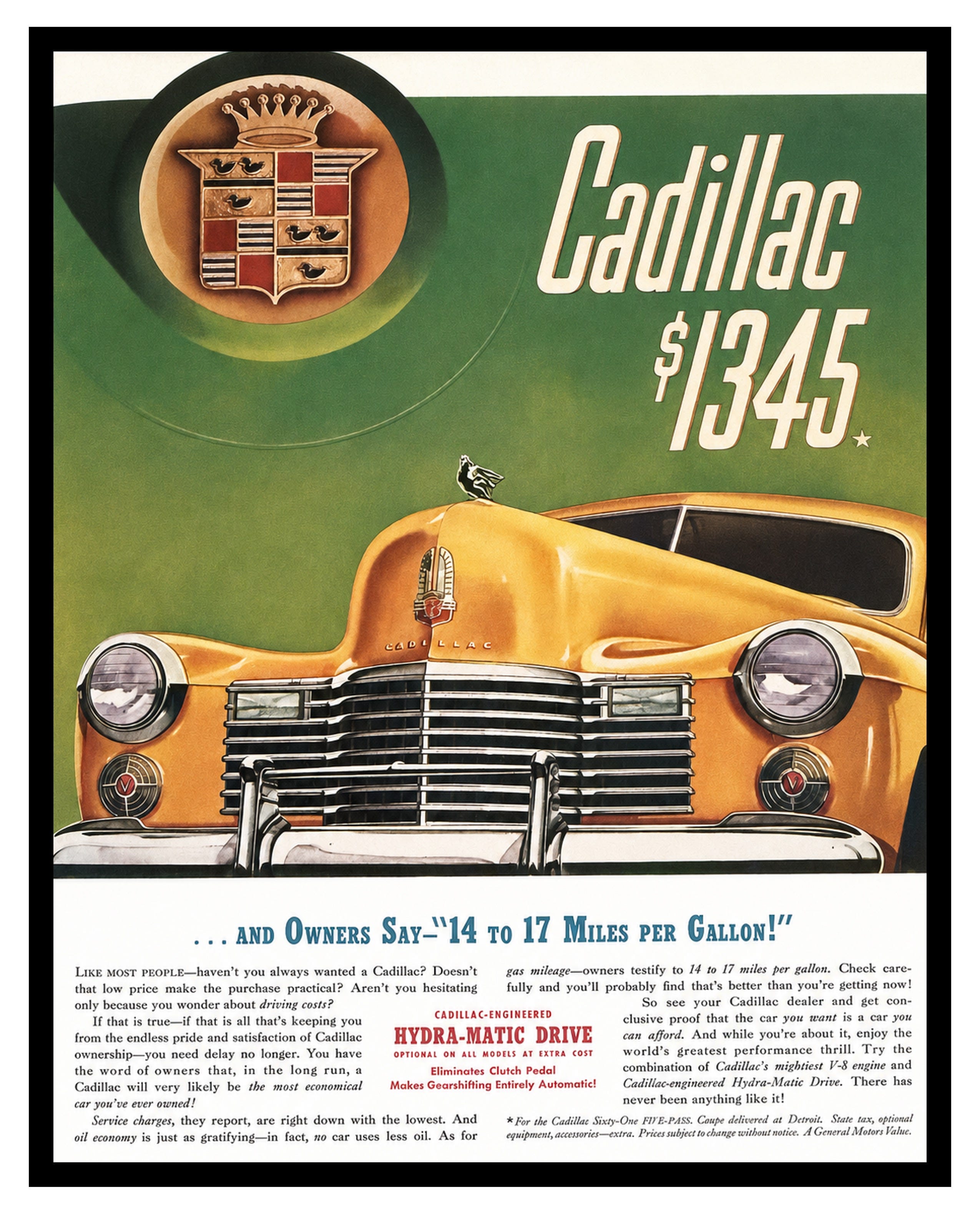
Today, most cars available to the average consumer can easily outperform the 14 to 17 miles per gallon advertised by the 1941 Cadillac, which is comforting, I suppose, in the same way it is comforting to learn that modern medicine has advanced beyond leeches. Fuel efficiency is now treated as a major selling point in much of the world. In America, however, its importance tends to rise and fall with the price displayed on the gas station sign. When gas is cheap, we rediscover our love of size, horsepower, and vehicles large enough to suggest we are preparing to tow a house.
Having lived in several regions of the United States, I have come to believe that Americans care about fuel efficiency in the same way they care about flossing: sincerely, briefly, and usually after something has gone wrong. Gas prices rise, and suddenly everyone becomes an amateur energy economist. Gas prices fall, and we return to our regularly scheduled programming: large vehicles, vague lifestyle justifications, and the quiet belief that the laws of physics are negotiable if the monthly payment is low enough.
The last few major gas-price panics: the 2008 depression, the COVID-era disruption, and Trump’s attempt at creating WWIII, all produced the same temporary revelation: maybe driving a vehicle that drinks fuel like it has unresolved emotional needs is expensive. But the revelation never lasts. Once the price at the pump becomes tolerable again, fuel economy goes back to being something people claim to value while shopping for the automotive equivalent of a studio apartment.
Across blue states and red states alike, Americans have found ways to make poor fuel economy feel like a personality trait. In the Midwest, this often takes the form of the oversized pickup truck. A vehicle theoretically designed for hauling lumber, livestock, and equipment, but frequently used to transport one laptop bag and a sack of groceries from Walmart. High school and college parking lots are full of trucks large enough to suggest their owners are operating a small ranch, though the nearest many of them get to livestock is ordering a burger after class.
Could many of these drivers get by with a Toyota or Honda that gets three or four times the fuel economy? Of course. But then the vehicle would merely function as transportation, which is apparently not the assignment. The truck is doing other work. It signals toughness, independence, masculinity, and a general willingness to reverse into parking spaces with unnecessary confidence.
The coastal version is not that different. There, the truck is often replaced by the Jeep. A vehicle purchased, at least in theory, for off-roading and communion with the wilderness. In practice, many Jeeps seem to spend their lives driving to state parks, parking beside Corollas, and proving that a person can love nature while burning through gas with impressive commitment. A Prius may get you to the same trailhead, but it does not say, “I have a complicated relationship with REI.”
If gas prices stay high, I imagine we will see another brief national shift toward fuel efficiency. The same country that once shed Hummers in the late aughts may rediscover the compact car with the solemnity of a people uncovering fire. There will be earnest conversations about hybrids. Someone’s neighbor will sell a Jeep and call it “a financial decision,” as though the vehicle had not spent the previous five years making the same argument from the driveway.
But eventually, if prices fall, the lesson will probably evaporate. It usually does. Americans will once again remember that what they truly wanted was not the economy, exactly, but presence. Height, weight, chrome, clearance, the ability to look prepared for weather that is not happening. The 1941 Cadillac promised 14 to 17 miles per gallon as evidence of restraint. Nearly a century later, plenty of us are still getting the same mileage. Only now we call it a lifestyle.